 English
 Español
A carton plant floor supervisor once told me, “We don’t own machines; we just borrow time from them.” He had spent that morning troubleshooting an unplanned stoppage on a high-speed gluing line—and the root cause, as it often is, wasn’t a catastrophic failure. It was a neglected air filter and a misaligned belt that had been “slightly off” for weeks. Those tiny oversights cascaded into 11 hours of lost production.
When automation runs packaging lines, reliability isn’t a nice-to-have; it’s the only thing that protects margins. Whether you’re forming simple shipping cases or manufacturing precision rigid boxes for luxury goods, the gap between 95% and 99.5% uptime is where profitability is won or lost. And that gap almost always comes down to maintenance discipline—not just doing it, but doing it in a way that matches the specific stresses your equipment faces.
1. Start with the rhythm your equipment actually lives by
Most maintenance schedules are written around calendar days. But packaging automation doesn’t wear out by the calendar—it degrades by cycle count, material type, and environment. A machine running 24/5 on abrasive kraft board needs a completely different care rhythm than one running two shifts on coated SBS.
A maintenance supervisor I work with shifted from monthly greasing to a cycle-based trigger for their durable rigid box forming systems. They programmed the HMI to flag a lube alert every 80,000 cycles. Bearing replacements dropped by nearly half within the first year. The lesson: let the machine’s actual workload, not the wall clock, dictate the preventive routine.
For most automated packaging gear, three rhythms make sense:
-
Daily operator checks: walk-around visual inspection, clear debris from vacuum ports and sensors, verify guard interlocks.
-
Cycle-based deep cleans: every X cycles (track it by product batch or counter), open the guarding, clean adhesive buildup from applicator heads, check belt tension, and vacuum electrical cabinets.
-
Annual alignment and calibration: laser-align drive shafts, verify squareness of forming mandrels, re-calibrate servo feedback loops.
Adhesive residue and paper dust are the two stealth killers in box-making environments. They invade bearings, clog vacuum generators, and foul optical sensors. A daily five-minute wipe-down at shift change isn’t housekeeping—it’s the cheapest insurance policy you’ll ever buy.
2. Lubrication: the discipline that separates veterans from rookies
I’ve seen plants use four different greases on the same line simply because “that’s what was in the storeroom.” That’s not lubrication—it’s gambling. Incompatible thickeners can harden inside linear guides and accelerate wear faster than no grease at all.
For automated packaging equipment, standardize on a single high-grade lithium-complex grease (NLGI #2) for most plain and rolling-element bearings, unless the OEM specifies otherwise. Critical areas to watch:
-
Cam followers and roller chains on the carton erecting station
-
Linear rails on servo-driven plungers
-
Rotary union seals on vacuum drums
Over-greasing is just as damaging as under-greasing. Pumping too much grease into a sealed bearing can blow out the shield, letting paper dust in. A good rule of thumb: inject until you feel slight back pressure, then stop. Better yet, switch to automatic single-point lubricators that meter precise amounts over time. These small devices pay for themselves in one avoided bearing failure on a critical path.
3. Calibration drift happens slowly—catch it before the box does
Every box-making operation depends on geometric precision. A forming head that’s out of square by half a millimeter might still produce acceptable boxes today, but the extra friction will chew through belts and guides over time. Worse, the product quality drift is so gradual that operators adjust visually, compounding the error week by week.
Schedule a quarterly “geometry day.” Use calibrated squares, dial indicators, and laser alignment tools to verify:
-
Parallelism of side guides and pressing plates
-
Squareness of folding arms at all four corners
-
Wrapping roller pressure symmetry (uneven pressure causes warped lids)
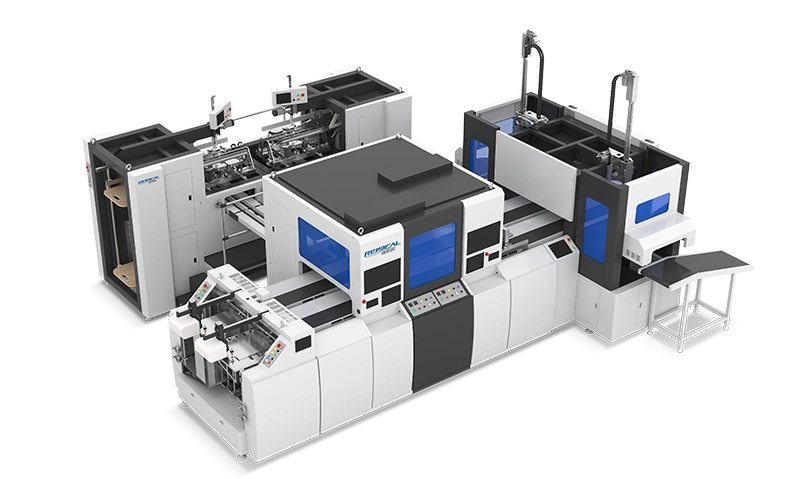
When you’re working with a high-output system such as an Automatic Rigid Box Making Machine, these calibration checks become even more critical. The complex kinematics of corner-wrapping, base-and-lid forming, and magnetic flap positioning multiply the effect of any drift. One operator told me his team caught a 0.3° misalignment during a geometry day that was causing intermittent jamming—a problem that had cost an estimated 40 hours of troubleshooting over the previous three months. A single hour of laser alignment fixed it.
Document every calibration value in a log that stays with the machine. Trends will tell you which assemblies are wearing faster and need engineering attention before they become emergency work orders.
4. The electrical side doesn’t “just work” forever
Automated packaging gear has migrated from relay logic to PLCs, servo drives, and networked I/O. That brings enormous flexibility, but also a new class of maintenance: electrical housekeeping.
Three non-negotiable practices:
-
Thermal imaging: Once a quarter, scan control panels and motor terminal boxes with a thermal camera. A hot spot on a contactor, circuit breaker, or drive indicates high resistance—often from a loose connection—and will eventually cause a nuisance trip or fire.
-
Cabinet climate: Verify enclosure cooling fans and air conditioners are functional. Excessive heat reduces capacitor life in drives. Keep cabinet doors closed—paper dust inside a VFD is a short circuit waiting to happen.
-
Firmware discipline: Don’t update drive or PLC firmware just because a new version exists. But do track the installed versions and review OEM service bulletins annually. A known firmware bug can cause erratic motion faults that look mechanical and waste days of troubleshooting.
A common mistake is treating electrical faults as one-offs. If an overload trips, find the mechanical root cause (a binding bearing, a jam) before resetting. Resetting without investigation is how motors burn out.
5. The human component: build checklists that actually get used
Maintenance procedures that sit in a binder on a shelf help no one. I’ve seen the most success with laminated, one-page checklists at each machine station, written in the operator’s language, with photos of what “good” and “bad” look like. For instance, “Good: belt sits centered on crown pulley. Bad: belt rides against flange (photo). Action: adjust tension equally on both sides.”
Train operators not just to follow the checklist, but to understand the “why” behind each step. When people know that a dirty vacuum filter makes the suction cup miss a pick—and that missed pick snowballs into a machine starved at the next station—they inspect it with purpose, not obligation.
If you’re evaluating new equipment, consider how the manufacturer designs for maintainability. Some well-engineered rigid box assembly units position vacuum generators and filter elements behind quick-access panels; others bury them behind bolted sheet metal that nobody wants to remove. Ten extra seconds of access time per shift translates to maintenance tasks that get skipped when production pressure mounts. Later, when you’re ready to expand capacity, you may want to explore advanced box production solutions that reduce the long-term care burden.
6. When to bring in outside expertise
Even the best internal team can’t know every nuance of every machine. Develop relationships with the equipment supplier’s service engineers. Schedule a preventive maintenance audit at least every two years—a trained technician who sees dozens of identical lines will spot emerging patterns your team might miss.
During one such audit on an Automatic Rigid Box Making Machine, the service engineer noticed that a vacuum pump’s duty cycle had crept up from 40% to 65% over 18 months. Nobody had flagged it because “it still worked.” The culprit was a slowly clogging exhaust silencer—a $40 part that could have taken down the entire vacuum system. The lesson: pay attention to leading indicators (duty cycle, temperature, cycle time) not just breakdowns.
Keeping the line young as it ages
Automated packaging gear isn’t like a pickup truck where you can postpone maintenance until something feels loose. The systems are interdependent. A sticky pneumatic cylinder delays a folding arm; the delayed arm confuses the sensor logic; the confused logic triggers an emergency stop. The cascade usually traces back to something small and utterly preventable.
Build your maintenance culture around cycle-based rhythms, lubrication discipline, geometric verification, and electrical housekeeping. Document relentlessly. Train for understanding. And when you’re assessing new machines or looking to bring more predictability to a growing operation, it’s worth considering how the equipment’s design itself contributes to easier upkeep. If you’d like to see what a maintenance-friendly packaging automation line looks like, you can check the latest configuration options here.
Disclaimer: The maintenance practices described in this article are general recommendations based on industry experience. Always follow the specific maintenance manuals and safety protocols provided by your equipment manufacturer. Some procedures may require qualified technicians and adherence to local regulations.