 English
 Español
A rigid box plant in Taichung was running 14-hour shifts just to meet Mother’s Day deadlines. The bottleneck wasn’t printing, not cutting—it was the corner stations. Eight workers stood pasting corners one by one, and the line still lost 90 minutes of output every day. The owner knew they needed change, but the box mix changed weekly: deep telescopic lids on Monday, slim book-style cases on Wednesday. The real question wasn’t “can we go faster?” but “how do we build speed into a process that handles so many formats?”
That plant’s story reflects a pain point familiar to any finishing manager: corner bonding is the step where flexibility collides with cycle time. Whether you produce rigid set-up boxes, magnet-closure gift boxes, or drawer-style slide cases, joint assembly often determines final throughput. Enhancing corner bonding speed therefore isn’t about one miracle tool. It demands a layered approach—starting with what you can fix at the bench, then evaluating when mechanized assistance makes financial sense.
Why corners slow down first
Before chasing speed, it helps to dissect why corners become the fulcrum of delay. Three factors interact:
-
Adhesive open time vs. fixation time
Solvent-based cements can remain tacky for 40 seconds but take 3 minutes to grip firmly enough for the next step. Water-based white glues often demand 8–12 minutes under pressure. If the operator releases too soon, spring-back deforms the board. -
Format-dependent dwell pressure
A 90° corner on a shallow lid needs roughly 2 kgf of consistent pressure; a deep-book spine corner may need 5 kgf because the board memory is stronger. Hand pressing introduces variability, so operators over-clamp, wasting cycle time. -
Sequential workflow design
Many workstations process all four corners linearly, so box travels through eight hands. That multiplies coordination loss and creates waiting waste.
A study from the International Journal of Packaging Technology and Research (2023) benchmarked manual corner pasting across 12 factories and found that average cycle time per box corner varied by 48% between operators, even when glue type and board grade were held constant. Reducing that scatter is the fastest lever—and it usually precedes any capital expenditure.
Tactical steps that raise baseline speed
Before automating, push your manual or semi-manual station as far as it can go. Small changes often reclaim 15–25% throughput.
Step 1: Match the adhesive to the substrate and ambient humidity
Hot-melt polyolefin (APAO) adhesives set in 5–12 seconds when pressed, which makes them ideal for high-mix lines—no drying racks needed. EVA-based hot melts are slightly cheaper but can show stringing above 60% relative humidity, which slows clean-up. For uncoated grey-board between 800–1200 gsm, a PUR warm-melt often delivers the best strength-to-speed ratio, with an open time under 20 seconds and full structural cure in six hours. Keep a simple log of glue temperature, substrate moisture content (target 8–12%), and set time; after two weeks, you will see a pattern that lets you set exact press windows per box grade.
Step 2: Build format-specific pressure jigs
A quick-change jig that matches the corner radius (typically 2–4 mm for rigid boxes) and applies even pneumatic or toggle pressure can slash cycle time in half. Three sizes usually cover 80% of box formats. If pneumatic cylinders feel like a capital jump, even a bench-mounted lever press with an adjustable stop block removes the “finger guessing” penalty. One Suzhou plant reported that after installing simple spring-loaded corner fixtures, their average press time fell from 9 seconds to 3.2 seconds per corner.
Step 3: Re-layout the station as a U-cell
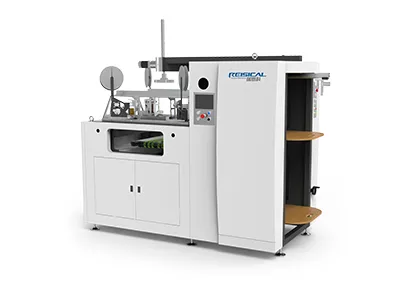
Instead of passing a box around four operators, a single operator can work a U-shaped fixture that presents two corners, rotates the box, and finishes the remaining pair. This cuts walking and handling, and because the same person controls the timeline, dwell pressure stays uniform. A time-motion test at the Taichung plant later showed that a U-cell arrangement raised output per person-hour by 38% for mixed box sizes—well before any automated assist was introduced.
When to shift from manual to integrated corner assembly
The ceiling of manual speed, even with optimal glue and jigs, typically sits around 300–350 corners per hour per operator. If demand pushes beyond that, or if order precision (e.g., luxury cosmetics packaging) demands zero visual deviation, the conversation turns to dedicated corner assembly systems.
Here, it pays to understand the landscape across three tiers:
| Tier | Approach | Speed per corner | Changeover time | Suitable for |
|---|---|---|---|---|
| 1 | Manual + fixture | 8–12 seconds | ~30 seconds (jig swap) | Under 2,000 boxes/day, high mix |
| 2 | Semi-automatic corner press | 2–4 seconds | 1–3 minutes | 2,000–6,000 boxes/day, medium mix |
| 3 | Integrated corner processing cell | 1–2 seconds | <90 seconds (auto-calibration) | Over 6,000 boxes/day, any mix |
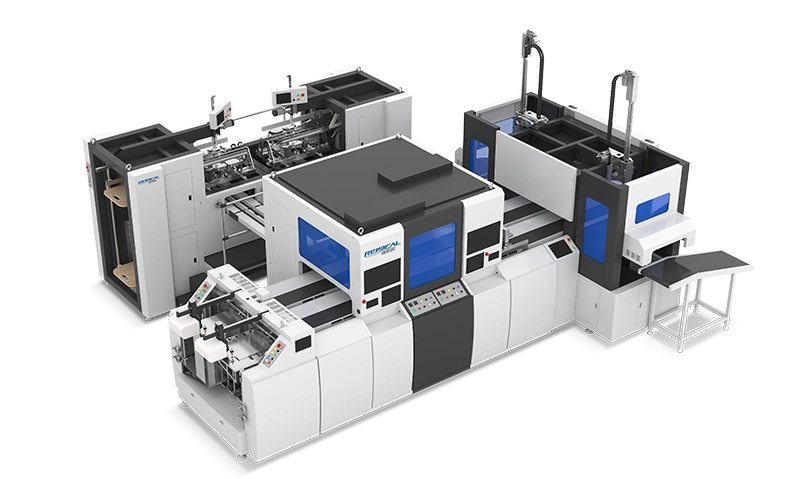
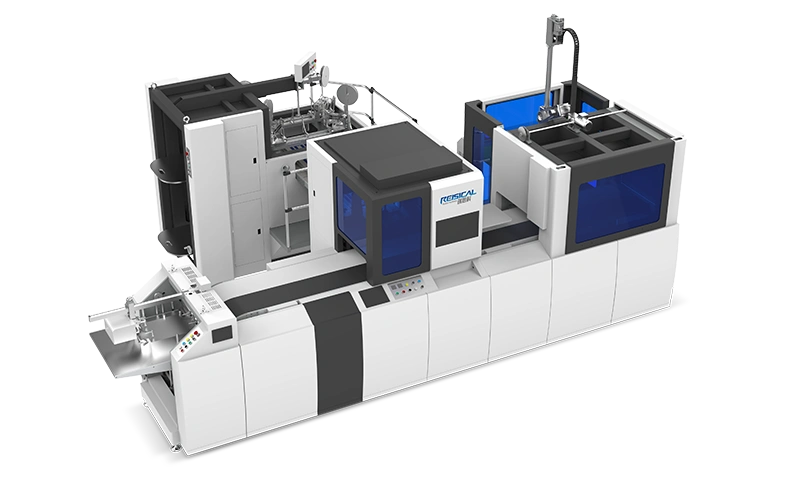
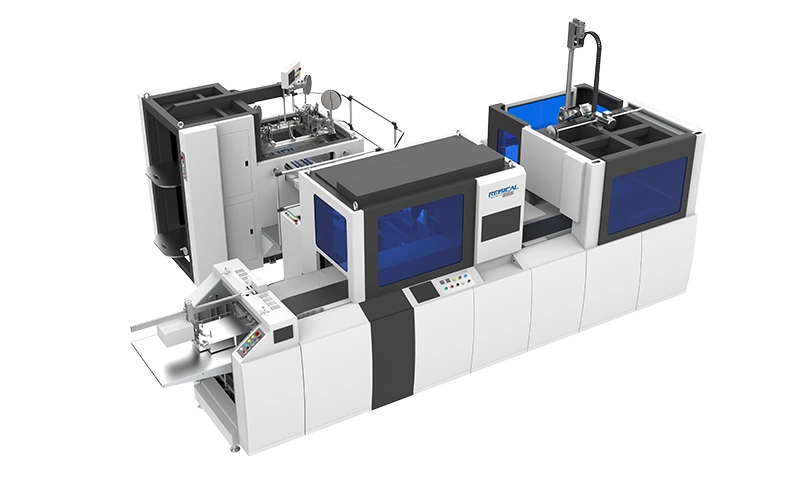
Tier‑3 systems can process all four corners of a telescopic lid in a single cycle, using servo-driven pressing blocks that adapt pressure curve to board thickness and corner radius. This is where corner pasting machine design has evolved furthest in the last five years—moving from mechanical cam‑driven movement to programmable multi-axis control. When a facility runs more than 12 box formats per week, the digital recipe storage of such systems eliminates setup error and drops changeover time to under 90 seconds.
Balancing speed with durability: the cold-foil & high-adhesion trap
A hidden enemy of corner bonding speed is the embellishment trend. Metallic cold foil, soft-touch lamination, and UV spot coating on the wrap paper reduce adhesive penetration. If you push speed without adjusting parameters, you get delamination returns. The fix is pre-treatment: a corona or primer pass on the coated side of the paper increases dyne level above 42 mN/m, allowing hot-melt to bond in the same short cycle time. This small step, done inline, prevents the quality‑speed trade-off that haunts premium packaging lines.
Pulling the levers in the right sequence
The Taichung plant finally broke their bottleneck by following a sequence that anyone can benchmark:
-
Standardized adhesive with a PUR warm-melt and fitted pre-heated nozzle applicators.
-
Rolled out three pneumatic corner jigs on a U‑cell layout, training operators in one-day conversion.
-
For high-volume telescopic lid runs, they introduced an integrated corner assembly system capable of 15 boxes per minute.
Within eight weeks, average per‑box corner bonding time dropped from 28 seconds to 4.8 seconds, while rework rate fell from 6% to 0.5%. The investment paid back in 7.2 months, driven mainly by labor reallocation and overtime elimination.
If your facility operates with a similar mix, the first recommendation is always to audit your glue and jig setup—that alone often unlocks 20% more speed. When the numbers justify moving toward automated corner bonding, the market offers modular systems that can start with a single format and scale later, which protects cash flow.
Should you be exploring how a connected, format-agile system could fit into your current floorplan, Ruisike’s engineering team has designed scalable corner bonding setups that work with mixed box sizes without lengthy retrofitting. You can find detailed configuration examples here and request a floorplan simulation based on your actual mix matrix.
Making speed stick
Sustained corner bonding speed relies less on one big purchase and more on process discipline: daily adhesive viscosity checks, documented jig pressure settings per SKU, and a simple photographic standard for acceptable corner seam appearance. With that foundation, whether you stay with a tuned manual cell or graduate to a high-speed corner bonding line, output becomes predictable—and predictable output is what fills peak-season orders without panic.