 English
 Español
Three months after installation, the machine sat idle. Not because it was broken, but because it couldn’t produce the large-format luxury gift boxes the client’s biggest customer suddenly demanded. The spec sheet had promised flexibility, but the bolt-on tooling couldn’t stretch beyond a predefined range. That conversion cost—factoring in delayed orders, rushed outsourcing, and management frustration—wiped out any initial price advantage. When investing in a rigid box machine, even seasoned packaging converters can stumble into traps that look harmless on a spreadsheet but become devastating on the factory floor. The good news is that most of these missteps are predictable and entirely avoidable if you know where to look.
Mistake #1: Treating “Capacity” as a Single Number
Ask a buyer what capacity they need, and you’ll hear something like “30 boxes per minute.” But capacity isn’t a speedometer reading; it’s a web of interconnected variables that can make or break your production line. One plant we tracked discovered that their 30-box-per-minute target figure only applied to a narrow, 100×100×40 mm format. When they ran the taller, cylindrical-style rigid boxes common in spirits packaging, throughput collapsed by 40% because the feeder’s blank magazine geometry wasn’t optimized for that aspect ratio.
The root cause is often a procurement process that starts with a maximum output figure and ignores the full operating envelope. In practice, what you really need to map are the dimension extremes you expect over the next three years—minimum and maximum length, width, and height—and the changeover frequency between those formats. According to feedback from a large cosmetics co-packer, short-run specialty orders now make up 35% of their volume. Their profitability hinges entirely on how fast they can switch from one size to another without tools or skilled technicians.
Before you set a specification in stone, benchmark your last 18 months of orders. What were the top five box sizes? How quickly did you need to flip from one to the next? The answers often reveal that a slightly different frame size or a modular tooling concept—where size parts can be swapped in under five minutes—will pay for itself within the first year of operation. If you’d like to explore how modular configurations handle real-world format variety, explore the modular changeover approach that some modern lines now offer.
Mistake #2: Confusing the Purchase Price with a Five-Year Investment
The second mistake is so common it has become a running joke on factory floors: “We saved 15% on the invoice and spent 30% more keeping it running.” Total cost of ownership (TCO) for automated box-making equipment extends far beyond the initial capital expense. It swallows adhesive consumption, electrical energy, preventive maintenance parts, unscheduled downtime, and the operator training hours that compound when an interface isn’t intuitive.
Drawing on aggregated data from packaging line audits, the purchase price typically accounts for only 55–65% of the five-year expenditure for a mid-speed line. The remaining leaks come from three areas: consumable inefficiency (uneven hot-melt application that boosts glue usage by 10–15%), mechanical wear on non-premium linear guides that demand replacement twice as often, and the productivity lost during changeover when the human-machine interface (HMI) lacks recipe management. One independent reliability study noted that servo-driven systems with absolute encoders reduced recalibration after format change by 70%—but only if the control architecture was designed around automatic position recovery rather than manual homing.
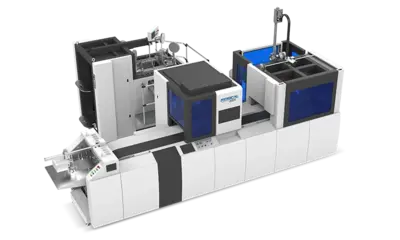
What’s insidious about TCO is that many of its components are invisible during a showroom demonstration. You won’t see the maintenance backlog, the glue build-up on scrapers, or the tiny misalignment that will cause corner paper crush six months in. The simplest countermeasure is to request a standard maintenance schedule and spare parts price list before finalizing the order. Compare the recommended intervals for timing belt replacements, bearing lubrication, and filter changes. A machine designed with centralized lubrication points and clear, numbered service panels signals that the manufacturer built for serviceability. For a deeper look at what a service-optimized layout includes, you can request a maintenance cost breakdown from suppliers who publish these details openly.
Mistake #3: Assuming All Glue Systems Are Created Equal
If there’s one subsystem that separates frustration from flawless boxes, it’s the glue application. Superficially, both a roller-based system and a nozzle extrusion system “apply adhesive.” In reality, they govern your scrap rate, your box’s visual consistency, and the very possibility of running certain coated stocks.
In a roller setup, film thickness depends on gap adjustment and speed, which drifts subtly as the adhesive warms up. A high-end spirits brand we consulted for recalled a batch where the covering paper developed a faint ripple pattern—barely perceptible to the eye, but unacceptable for a luxury unboxing experience. The root cause was a temperature-induced viscosity shift that a closed-loop viscometer could have corrected in real time. Equipment that integrates a hot-melt viscosity control with automatic temperature compensation can maintain film thickness within ±5 microns across a full shift, something an open-loop system simply cannot guarantee.
The other dimension is glue pattern customization. Many rigid box designs today require spot gluing—applying adhesive only where the chipboard meets the wrap, leaving a clean margin along the edge. Doing this manually with tape or masks is time-consuming and unreliable. Programmable nozzle arrays, combined with encoder-tracking of the board position, let you define the exact glue area from the HMI screen. One packaging engineer described the shift to programmable gluing as “going from spray paint to a laser printer.” When you examine technical specifications, pay attention to terms like servo-synchronized glue tracking and individual nozzle control, and ask for sample runs on your own materials rather than the supplier’s pre-optimized demo stock. To understand how precision glue control translates into final box quality, review the glue system specifications many manufacturers now document in a downloadable technical datasheet.
Mistake #4: Not Stress-Testing the Support Network
Every machine ships with a warranty, but warranty clauses don’t keep your line running when a servo drive fault triggers at 2 a.m. ahead of a seasonal peak. A mid-sized converter in Southeast Asia shared a hard lesson: a critical power module failed, and the supplier’s nearest spare part was eight time zones away with a two-week lead time. The converter lost not just the production hours but the confidence of a key e-commerce client—a loss far greater than any piece of hardware.
Support isn’t just about having a phone number. It’s about local spare parts buffers, remote diagnostic capability, and the depth of application expertise your supplier can deploy. As packaging lines integrate more IoT sensors and condition-monitoring algorithms, the ability for a technician to remotely log in—with your permission—and read error logs while you’re still describing the symptom can shave days off a repair cycle. According to industry guidelines, critical control components should have a modular architecture where a hot-swappable axis drive can be replaced without re-tuning the servo loop, drastically reducing mean time to recovery.
Before you sign, map out the support escalation path. Where is the nearest field service engineer? What’s the typical response time for on-site visits? Can you talk to a reference customer who has faced a serious breakdown? When producers invest in packaging equipment with a ten- to fifteen-year lifecycle horizon, the partnership matters as much as the hardware. RUISIKE, for instance, has organized its support infrastructure around remote troubleshooting and stocks a curated inventory of high-wear and electronic components in regional service hubs. If you value consistent uptime and want to understand what a supportive partnership looks like, visit their product page to learn more about their uptime philosophy.
Asking the Right Questions, Far Earlier
The thread connecting these four mistakes is a single insight: the decision moment that matters most isn’t the final negotiation—it’s the very first technical scoping, long before you see a price tag. When you frame your search around dimensions first, TCO second, process precision third, and support fourth, the selection criteria becomes a filtering tool that naturally eliminates equipment built for brochure specs rather than daily reality.
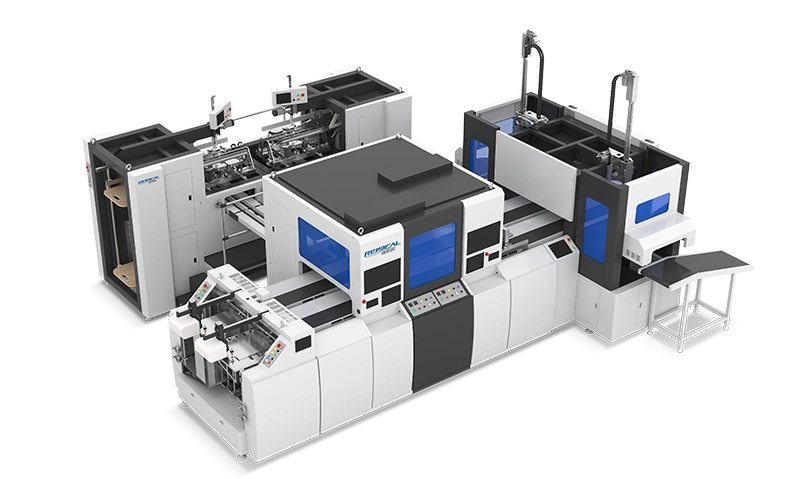
One final suggestion: insist on producing your own stock in a trial run. Use your actual paper, your actual chipboard, your most demanding format. Watch the operator—not the demo specialist—load the magazine and change the size set. That single exercise, repeated across two or three different days, often reveals more than any datasheet. Avoiding these pitfalls isn’t about memorizing a checklist; it’s about cultivating a buying process that systematically exposes the friction points before they cost you money. For an equipment solution that has been engineered with these real-world production pressures in mind, you can explore the full range of automated rigid box solutions here.